The Sabbath
A palace in time.
For every week this semester I observed a heavily modified version of the Sabbath. This was done primarily because I committed to the idea in public and I have an odd sense of honor. It was also an experiment in a burn-the-ships approach to internet addiction and an attempt to get closer to both the religion of my ancestors and religion in general (I spent the morning of one Saturday reading the Gospel of Mark).
The rules of the "Davidism Sabbath," as dubbed by my CS lecturer, were as follows:
Turn off my phone and laptop sometime Friday afternoon or evening, typically 5:30pm, often as late as 7:30 or as early as 3:30.
Turn them back on 24 hours later.
That's it.
I liked to imagine my weekly "Sabbath" as a kind of sleep for the week. A reset, if you will. Occasionally, when I was extremely tired, it was a time for sleep for the weak. There were multiple Saturdays where the lack of blue light blasting at me from a rectangle forced me to reckon with the realities of my own body. I slept because I couldn't read, couldn't exercise, and didn't have an easy out. My brother once said he just took a nap whenever he was too tired to read something complicated, and on Saturdays and Saturdays alone I lived that lifestyle.
The more useful kind of sleep was the break. The last semester I was at UMD I felt a constant need to be working on something. No matter what time it was, I could be doing homework, and there was always a small part of me that whispered I should be doing homework, or applying to internships, or any number of things besides whatever I was doing at that moment. Forcing myself away from the internet did not completely alleviate those voices, but it certainly made it so that there were fewer of them. There is something freeing about being unable to do much; being forced to stop working on the concerns of space and start working on a "palace in time" (Heschel, The Sabbath).
There's some interesting stuff going on in my palace in time. I do a lot of reading there, and the kind of reading I do there is different. There's a certain kind of enjoyment one gains from truly immersing oneself in a book. It's a kind of enjoyment I've been blessed to experience often throughout life. In this case, it happens with a wider range of books than normal. In darkness, dim lights shine like beacons. There are beautiful things that happen to my mind when I read deeply. It's one of the few things that makes my internal world more exciting while also making me calmer.
Like any palace, mine has walls. Throughout the semester I've been obsessed with different things throughout the week. Whether it be when I watched an abridged version of the entire One Piece anime, or my recent obsession with semiconductor stocks, these obsessions are often on the internet. They do not get past the walls of the palace.
During the week the flow of information is as an ocean of water. I do not drink. At best I swim, and often I get carried away. It's hard to overstate the amount of stimulus that enters my brain when I open my laptop. It is not unreasonable for me to be tracking eight different stocks at all times of day (the Korean stock market opens at 8pm), perusing responses from multiple AI models, ostensibly working on an English assignment, reading tweets about the Knicks, and playing a hand of online poker at the same time. I do love that kind of experience, but it lacks heft. If you carry that many things on your mind they have to be light.
The Sabbath also provides a discontinuity in time. I am bad with continuous things. I can internalize the probability of many discrete events, but once you get them trending towards infinity I lose that kind of deep understanding. I likewise struggle with the continuity of time. I often lose weeks to a feeling of similar days blending together. The break in time provided by this experiment helped with that. To butcher a phrase: there was a day of the week that was different from all other days.
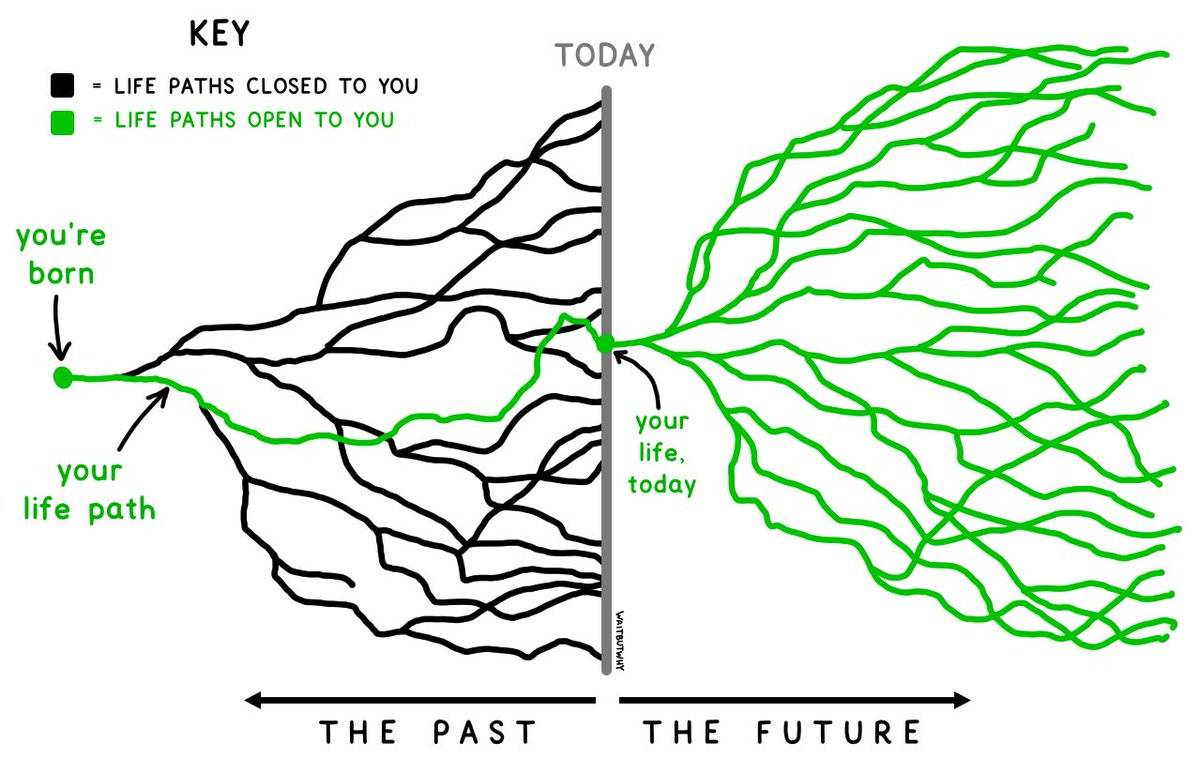
Tim Urban, Wait But Why
There is a collection of a certain type of image which I enjoy. One of them is this illustration by Tim Urban from Wait But Why. Another is the light cone:
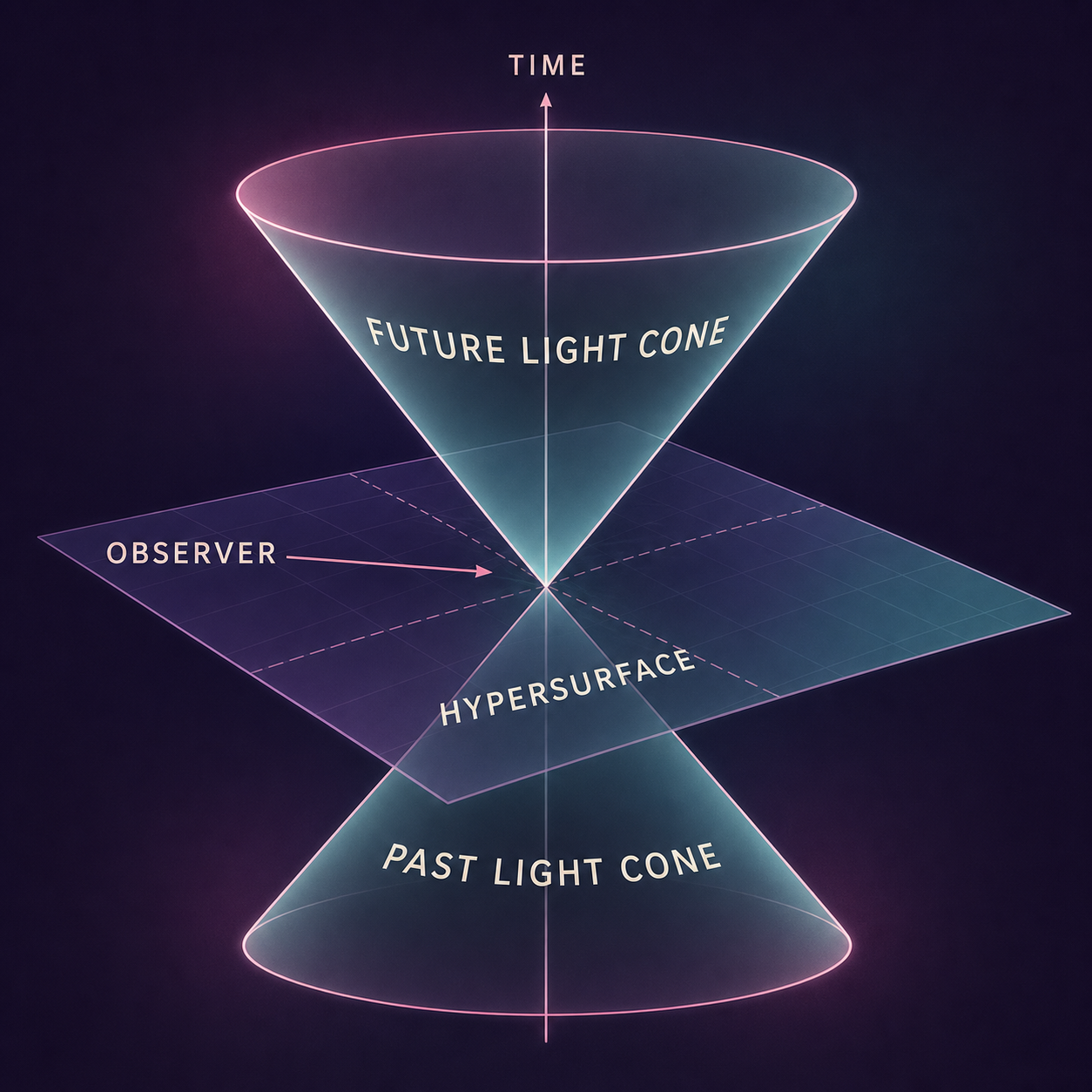
They both provide a way of looking at time that I think is useful here.
We live at the center of the hourglass between two cones, but rarely do we spend much attention there. The cones are so much bigger, more enchanting. "Imagining the future is a kind of nostalgia" (Sarah Urist Green), and imagining the past, well, yeah.
One of the realizations I've had as I've matured, a wonderful word for implying you're a better person than you used to be, is that all the damn cliches were right. Living life in the present is actually kinda great. Expect a future blog post on the apparently Quixotic task of instilling wisdom into words, or just read the Buddha.